Written by: Nabil Amdan
Canada’s watchmaking story begins humbly with imported parts and local craftsmanship. In the 18th and 19th centuries, Canadian watchmakers typically finished movements (ébauches) made abroad rather than producing them from scratch. A goldsmith or jeweler would often assemble a watch for a customer, stamping it with their own initials or company name. This private-label practice persisted even into the 20th century: for example, jewellers often assembled watches from parts to dodge high tariffs on complete timepieces. Canadian towns took pride in precision timekeepers; the earliest public clocks such as the St. Sulpice Seminary clock in Montréal, c.1701, and Halifax’s famous 1805 Town Clock, were prestige symbols. Indeed, into the early 1900s a well-made clock, often with an imported movement in a locally made case, was a treasured household heirloom. In this setting, the wristwatch eventually emerged as the modern successor to the tall case clock; a status symbol marking the rise of a mobile, middle-class culture.

From the outset, department stores and jewelers were key to the Canadian watch trade. Major retailers like Eaton’s and Birks stocked and even commissioned watches. Eaton’s in particular created its own “Solar” brand of house watches, sometimes co-produced with Swiss firm. These stores advertised watches as the quintessential gift: ads from the 1930s and ’40s touted fine timepieces as “the gift the graduate expects” or as tokens of affection. By mid-century, owning a Swiss or well-crafted watch was seen as a marker of personal success and modernity. Indeed, ads in Eaton’s catalogues and the Sears and Simpson’s mail-order books offered everything from gold Rolexes to affordable Timex models, reflecting a broadening market.

Watches also played social roles beyond mere timekeeping. In the early 20th century, reaching adulthood was often marked by receiving a watch, symbolizing responsibility. Many Canadian men and women proudly wore longcase clocks or pocket watches passed down through generations, and later snapped up wristwatches that became heirloom keepsakes in their own right. In workplaces, watches even became awards: the most famous example is Eaton’s “Quarter Century Club.” Beginning in the 1930s, Eaton’s partnered with Rolex Canada to present a special Rolex watch to every employee who hit 25 years of service. These gold-filled “1/4 Century Club” watches bore only the Eaton name and the words “¼ Century Club” on the dial (the usual Rolex branding was stripped away). In this way, a timepiece itself became a badge of dedication and company pride. More broadly, department stores like Eaton’s and Simpson’s helped foster Canadian watch culture by branding, selling, and even manufacturing watches under their own names – all ranging from Eaton’s “Solar Aqua” line to Simpson’s jewelers’ labels.
Canada’s World War history deeply impacted its watchmaking. During the World Wars, Canada had little domestic watch industry, so military needs were met by imported timepieces and by soldiers’ own purchases. In the trenches of WWI, Allied armies relied on accurate timekeeping to coordinate barrages. Canadian gunners entrusted synchronized pocket or wristwatches with every move. Before 1914, wristwatches (often called “wristlets”) were mostly a feminine accessory, but the war transformed them into essential soldier’s kit. Surviving accounts show many Canadian officers lugging Waltham or Omega pocket watches, sometimes converted to wrist-wear with protective cages. Letters home mention soldiers treasuring their timepieces or requesting new ones: as one 1915 gunner wrote, “Your watch is invaluable to me here… there are only three of us carrying them”.

World War II saw a similar situation. Canadian forces imported vast quantities of Swiss and American watches. In fact, Canada’s military procurement records show that by the 1940s American and Swiss brands dominated Canadian-issued timepieces. The Canadian government issued standard field watches like the Hamilton-designed A-11 (British designation 6B/150) to Royal Canadian Air Force navigators, and it bought “luminous chronographs” for pilots. Canada also had “C-Broad-Arrow” markings (the British Crown property stamp) on watches used by its forces. Despite this standard issue gear, many Canadians still prized whatever good watch they could get. By some accounts, Rolex Canada even saw its debut consumer market as wartime soldiers: a fleet of 1930s-40s Rolex/Oyster and Tudor watches (with FHF movements) were quietly sold to Canadian servicemen. These included experimental models with names like “Corvette,” “Majestic,” “Seaforth,” and “Victory” – all unique dial variants tailored for Canada.
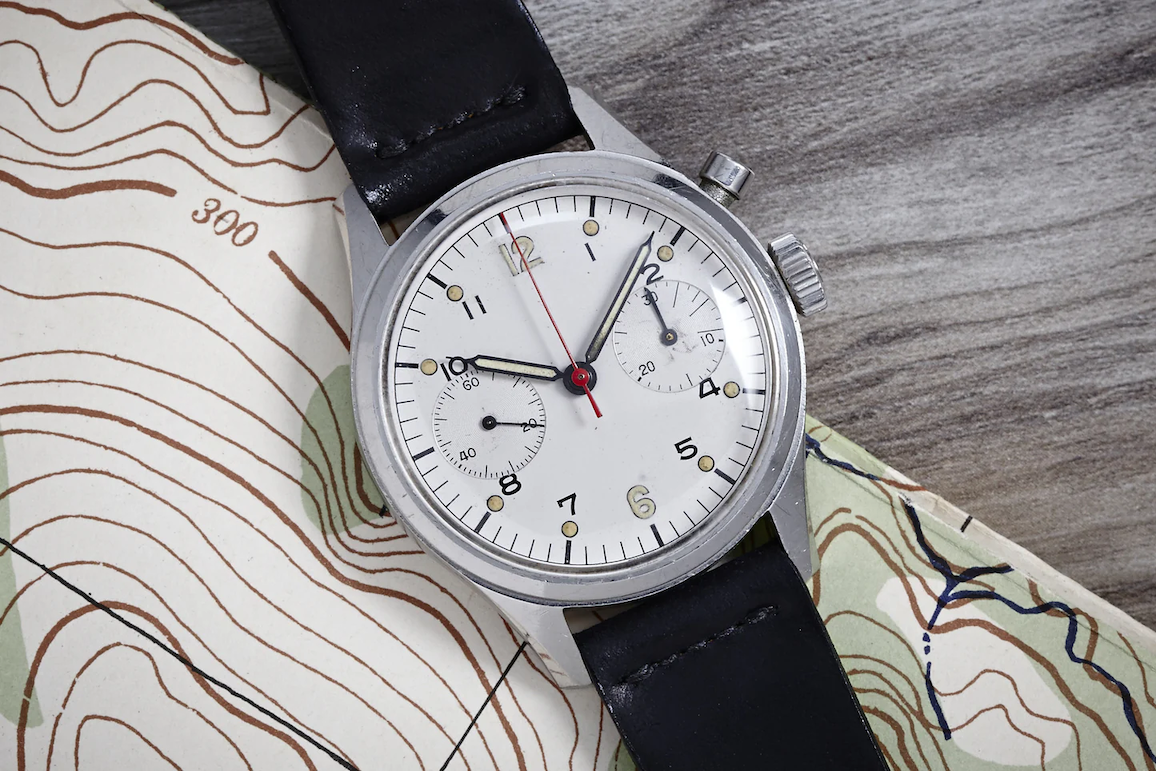
During WWII, Swiss watches surged in popularity among Canadians. Because Switzerland was neutral, its luxury watch industry was booming while competitors pivoted to war production. After 1945, returning Canadian veterans often kept their Swiss-made watches as personal symbols of endurance. (Swiss brands even arranged local assembly to dodge Canadian import taxes – Rolex, for example, produced Oyster cases in Montreal via partners like ID DiVincenzo & Arienti.) By the 1950s, owning a Swiss Rolex, Omega, or Hamilton was widely seen as both a status symbol and a practical necessity. The Royal Canadian Air Force officially adopted Omega chronographs for its pilots by the 1960s, and Canadian sailors wore Tudor Submariners in the Cold War.

Watches also served as meaningful tokens of military service and veteran commemoration. After WWII, surviving officers and communities often gifted engraved timepieces to heroes. For example, private Canadian soldiers wrote home asking for specific watches, and by war’s end communities presented officers with inscribed pocket watches (as with a Waltham pocket watch given to a VC recipient in 1919). Canada even has war records of watch orders: a 1951 Order-in-Council shows the government buying 2,000 “waterproof wristlet watches” at about $36 each for the armed forces (likely for the Korean War). These watches, supplied by Birch’s jeweller, underscore how timepieces were formally integrated into military kit.
For Canadian troops, a reliable watch was more than a gadget – it was literally lifesaving. By the mid-20th century, trench watches (sturdy pocket-watches converted with lugs) and then proper field wristwatches were standard. Legion Magazine notes that by WWII “the basic three-hand field wristwatch predominated” among Canadians, replacing earlier “General Service” pocket chronometers. RCAF navigators demanded watches with luminescent dials, sweep second-hands, and 24-hour markers; one airman in 1943 explicitly asked for “an Omega… the official [RCAF] watch”with those features. In effect, Canada’s military presence around the world turned every soldier and sailor into an ambassador of watch culture – both carrying Swiss and American brands and sometimes wearing Canadian-branded pieces like Eaton’s Solar or Birks-pocket models.
After the wars, Canadian watchmaking took new turns. Domestically, government protectionism and industrial policy played a role. To foster local industry, Canada maintained tariffs on foreign watches and even on precious-metal cases, prompting foreign firms to invest in Canadian facilities. For instance, Rolex’s move to have Oyster cases made in Montreal was largely to beat import taxes. Likewise, some American companies expanded north: Hamilton continued to ship movements into Canada, and Bulova sold locally assembled models. Ontario and Quebec emerged as watchmaking hubs: Ottawa was home to Bowmar Canada, which pivoted from electronics to digital watches in the 1970s, and Montreal housed Marathon Watch Co.

Bowmar (Ottawa) exemplifies the era’s consumer shifts. An electronics pioneer, Bowmar started producing LED digital wristwatches around 1973. Its “Cardinal” LED watch sold for roughly $250, a fraction of the price of the first Pulsar LED ($2500). This Canadian innovation rode the wave of the quartz revolution. Globally, Japanese firms like Seiko had launched the first quartz watch in 1969, dramatically undercutting mechanical watch prices. Canadians eagerly adopted these new technologies: cheap quartz and digital watches became ubiquitous by the late 1970s, and even homegrown companies embraced them. The Ottawa Ingenium (science museum) notes that Bowmar produced LED watches for about a decade beginning in 1973, showing how Canadian firms competed on price and novelty. Meanwhile, some traditional Canadian makers tried to stay afloat: Montreal’s Arthur Pequegnat clock company (famous for proud Canadian motifs on clocks) held out until 1941, and smaller firms like Wein Brothers/Marathon switched to war production in 1941.

By the 1960s and ’70s, foreign brands largely dominated Canadian retail, but domestic pride lingered. Marathon Watch Company, founded in Montreal in 1939, became Canada’s premier watch manufacturer. It built a reputation on rugged military tool watches, supplying Allied forces during WWII and beyond. (Marathon’s watches, still bearing “Swiss Made” on the dial, were designed in Canada and built in Switzerland, reflecting globalized production.) The company continued as a family business – even Oprah-endorsed Marathon, now run by the founder’s great-grandsons, remains the sole supplier of quartz watches to the U.S. military. While Marathon is unique, it symbolizes Canadian aspiration: precision craftsmanship, durability, and national service all in one brand.
Today, Canada’s watchmaking survives mainly through boutique brands and independent craftspeople. Halios Watches (Vancouver) is a notable example: founded in 2009, it produces rugged dive and sport watches. Halios sources its movements from Japan or Switzerland but has them assembled overseas; the final quality control and testing are done at Halios’s Vancouver headquarters. Similarly, there is a growing population of small watch brands growing in the Canadian space including Makoto Watches, Whitby Watches, ZENEA Watches, Solios and many others.

Beyond the multitude of Canadian microbrands, there is a small and select group of talented individual horological artisans reviving traditional watchmaking in Canada. A notable watchmaker in Canada is Aaron Sarauer, who brings another, deeper level of creativity in watchmaking from Saskatoon, Saskatchewan. A WOSTEP‑trained watchmaker, he founded Sarauer Horology to build one‑of‑a‑kind wristwatches whose movements are hand finished by himself. His Ref. 119C (limited to 29 pieces) uses an offset Unitas‑based SH1 hand‑wound movement, German silver mainplate and bridges, and a custom 316L stainless case. All finished, and assembled in his Saskatchewan atelier.

An outstanding and notable independent and Swiss trained watchmaker Bradley Taylor of North Vancouver has recently launched after four years in development, his latest release - the Ardea. This is Taylor’s first watch to feature both a completely developed in-house movement and all other aspects of the watch except the case. At its heart is the Calibre 475RS, a retrograde seconds complication developed in Taylor’s workshop, paired with a solid gold gear train, titanium and platinum balance wheel and a hand-guilloché fine silver dial crafted on a restored rose engine. Named after the herons near his riverside workshop, the Ardea blends technical artistry with soft, romantic design cues inspired by the bird’s swift, striking movement. Taylor’s watch, the Ardea is the only made in Canada watch to be fully commercially produced in Canada.
This modern scene sits in contrast to the old days of local assembling and war contracts, but continuity remains. Canadian identity and regional pride still influence watch culture. Owning a “Made in Montreal” or “Designed in Canada” watch resonates for some as a patriotic choice. Canadian military procurement continues (e.g. Maple Leaf editions by Marathon for Canadian forces), and vintage styles are revered by collectors. From the turn-of-the-century clockmaker’s shop to the new watch startup, the threads of culture and identity run through it all. In the end, the history of Canadian watches is as much about people as about gears: workers honored by presentation watches, families marking milestones with a timepiece, soldiers synchronizing batteries at Vimy Ridge, and proud manufacturers saying “Made in Canada.”
%201.png)
