Written by: Zahra Hemraj
Art has always been one of the ways I orient myself in the world. From working at Christie's and visiting fairs such as Frieze to spending long afternoons at the Musée de l'Orangerie, the San Francisco Museum of Modern Art, or closer to home at the Art Gallery of Ontario, I have learned to read art as a way of navigating places, ideas and culture, long before I read it as a subject.
That habit of looking closely has shaped the way I look at timepieces. A watch may be defined by precision, but it is experienced through proportion, material, colour, movement and emotion. Few illustrate the meeting of these worlds as vividly as the Audemars Piguet Royal Oak Concept Tourbillon "Companion," created with KAWS. His familiar figure occupies the centre of the watch, while the hour and minute display moves around its perimeter. The artwork does not merely decorate the dial. It changes how the watch is read.1
It raises the question at the heart of the relationship between art and horology: when does art become integral to a timepiece, rather than something placed upon it.
The connection between art and watchmaking is hardly new. Enamelling, engraving, miniature painting, marquetry and gem-setting have long allowed watchmakers to turn remarkably small surfaces into spaces of creative expression.
It would be easy to dismiss watches based on existing masterpieces as derivative. The artwork already exists, its reputation has been established, and the watchmaker appears simply to borrow from its cultural significance. Look closer at how that borrowing actually happens, though, and the picture gets more interesting.
Jaeger-LeCoultre's Reverso is especially suited to this kind of reinterpretation. Its reversible construction was originally conceived to protect the dial, but the metal reverse also created a private surface for engraving, personalization and decorative craft.
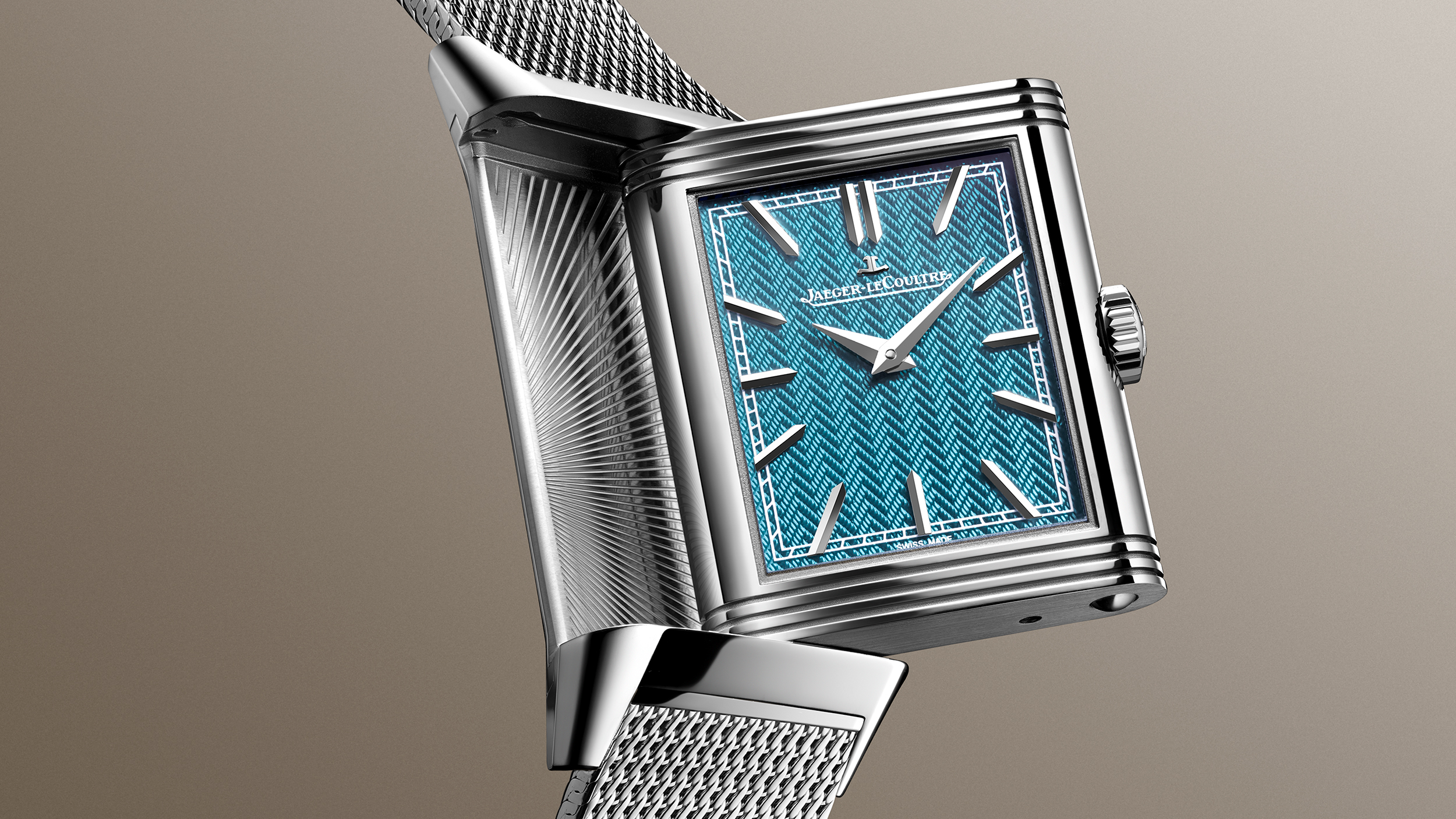
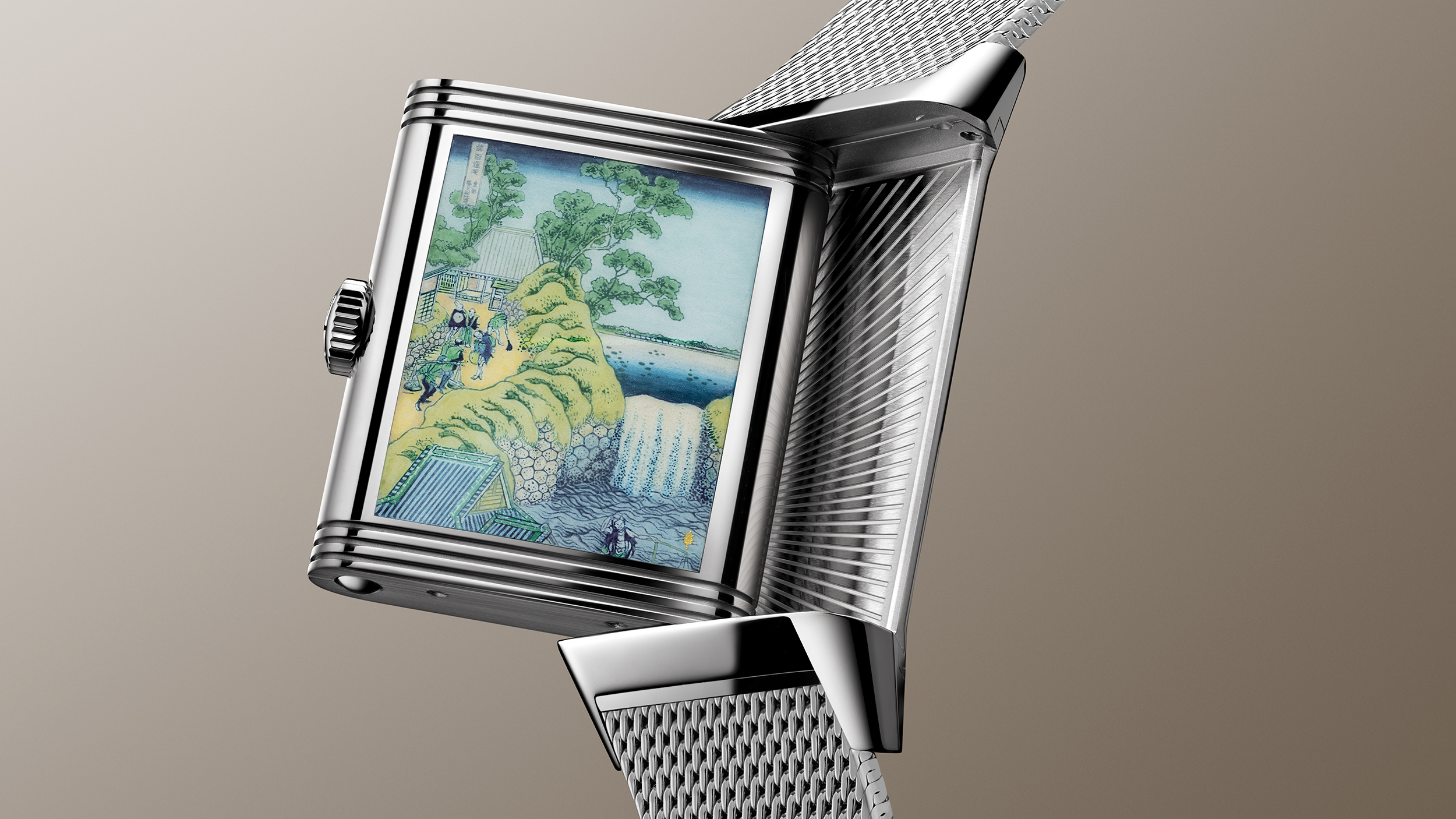
In the Reverso Tribute Enamel Hokusai series, works by Japanese artist Katsushika Hokusai are recreated across an area of approximately two square centimetres. According to Jaeger-LeCoultre, each miniature painting requires at least 14 layers of enamel, each fired at 800°C, and approximately 80 hours of work. The opposite dial combines hand-guilloché patterns with translucent grand feu enamel.2
Those figures demonstrate the technical difficulty, but they don't fully explain why the watch is compelling. A waterfall painted on paper and one reconstructed in enamel are not experienced the same way. Colour behaves differently, and depth has to be suggested on a tiny surface shaped by the proportions of a watch case. The enameller has to preserve the energy of the composition while working within a scale and material Hokusai never used.
The original image remains recognizable, but it takes on another physical presence: intimate, held in the hand, revealed only when the case is turned over. The watch can't replace the experience of seeing the original work, and it doesn't try to. It offers another encounter with it.
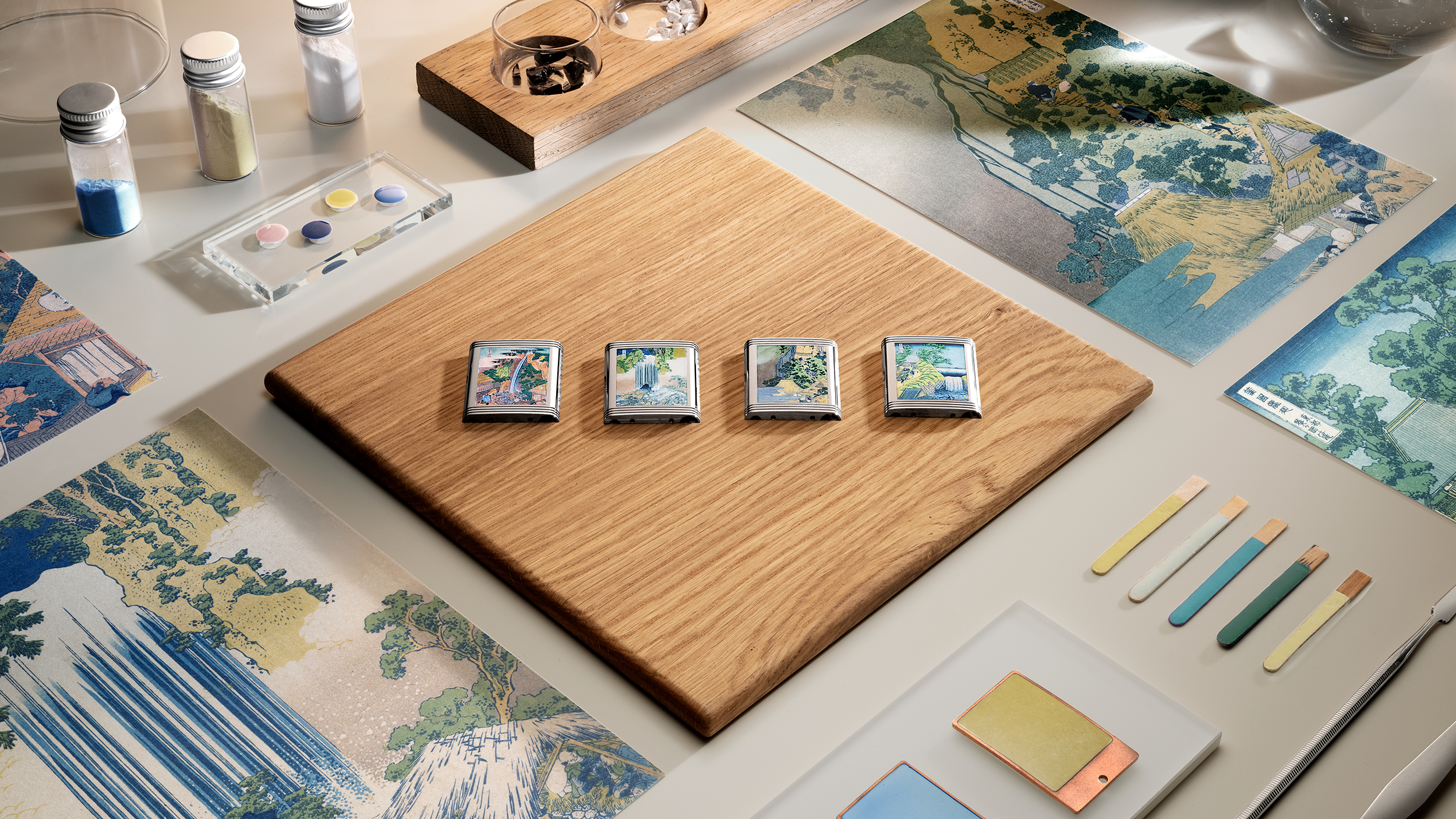
Vacheron Constantin's partnership with the Musée du Louvre in Paris expands the idea from a single artwork to objects associated with entire civilizations. Its Métiers d'Art Tribute to Great Civilisations collection interprets works from the museum's antiquities departments through engraving, enamel, stonework, marquetry, micro-mosaic and glyptics. For the collection's 2026 chapter, Vacheron Constantin worked with Louvre department heads to select works associated with Pharaonic Egypt, the Neo-Assyrian Empire, Ancient Greece and Imperial Rome. The watches were developed over three years, including an entire year devoted to thematic research.3
Curatorial knowledge enters the creative process here, rather than simply supporting the launch. The original objects are studied and contextualized before they are reconstructed through new materials and techniques; in some cases, stones were chosen for their similarity in nature or origin to those in the museum pieces. The Louvre contributes the historical knowledge, and the manufacture answers through craft, so what results is less a copy of the museum's objects than an interpretation of them, built at a different scale and for a different purpose.
Jaeger-LeCoultre and Vacheron Constantin begin with the past but arrive at different expressions. One transforms a specific artwork into a private miniature. The other brings museum scholarship into dialogue with several métiers d'art. Either way, the borrowed image ends up as a starting point rather than a finished idea.
With a living artist, the question shifts from how an existing work is translated to how much influence the artist has over the finished timepiece.
A recognizable image may attract attention, but recognition alone doesn't make a collaboration artistically significant. The more persuasive examples let the artist's visual language shape the form, mechanics or experience of the watch itself.
From a brand perspective, the appeal of an artist collaboration isn't hard to understand: it can generate immediate recognition, introduce a watch to a different audience and create a strong visual story around a launch. Those commercial advantages can also conceal a weak creative premise, since a successful campaign and a meaningful collaboration aren't automatically the same thing. What separates them is whether the partnership changes the product itself, or just how it's promoted.
VIEREN offers a more intimate form of co-creation and an important independent perspective. Founded in Toronto and producing its watches in La Chaux-de-Fonds, the brand marked its fifth anniversary with the V Collection: five artists, James Goldcrown, Roberta Boffo, Cosmodernism, Kelly Violet and Sébastien Preschoux, invited to reinterpret the same rectangular base watch, the OG Automatic Matte White, with the results presented together as a gallery-style experience. Each artist produced a hand-painted dial and artist-specific caseback from the same starting point, and the consistency of that starting point is what makes the differences between them so visible: pattern, colour, gesture and line alter the personality of the original watch without erasing it.4
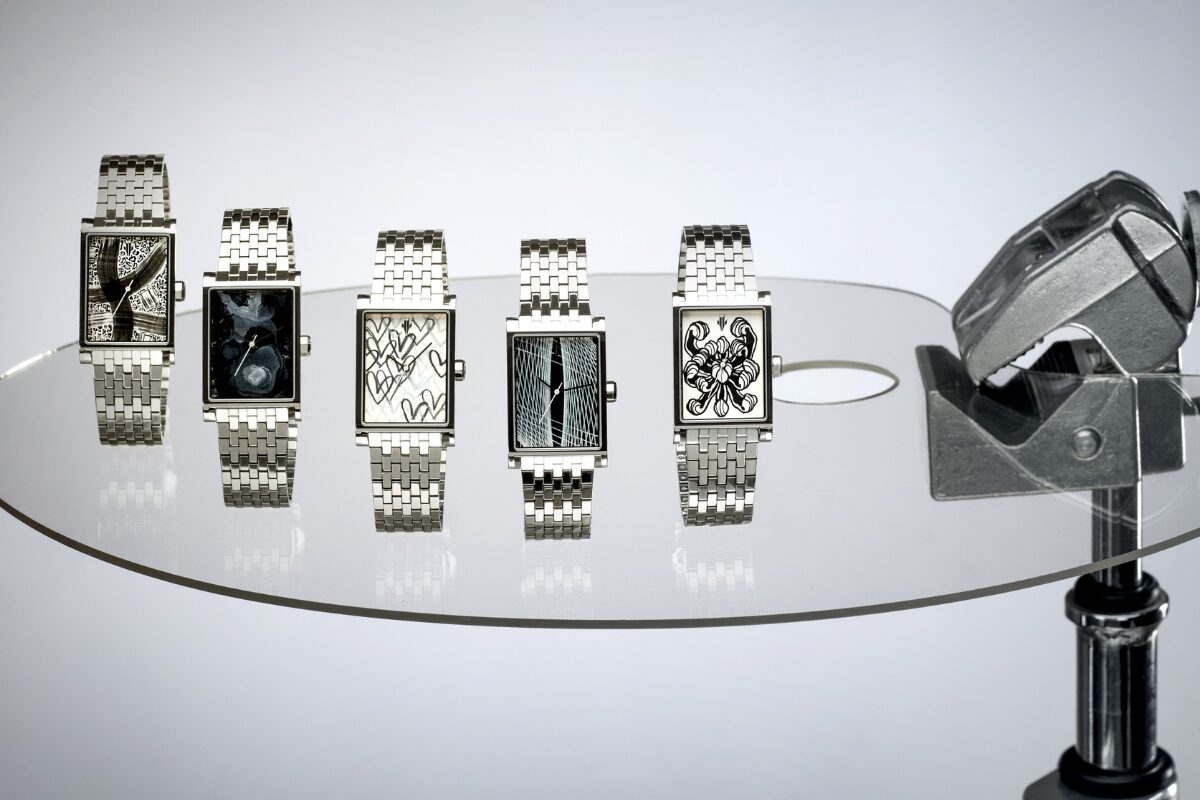
An established maison invites an artist to challenge or expand codes that collectors already recognize. VIEREN occupies a different position: for a younger independent brand, collaboration can help establish what those codes will become in the first place.
For Hublot and Audemars Piguet, the same principle operates differently: the artist is not helping define a young brand, but disrupting codes that have been established over decades.
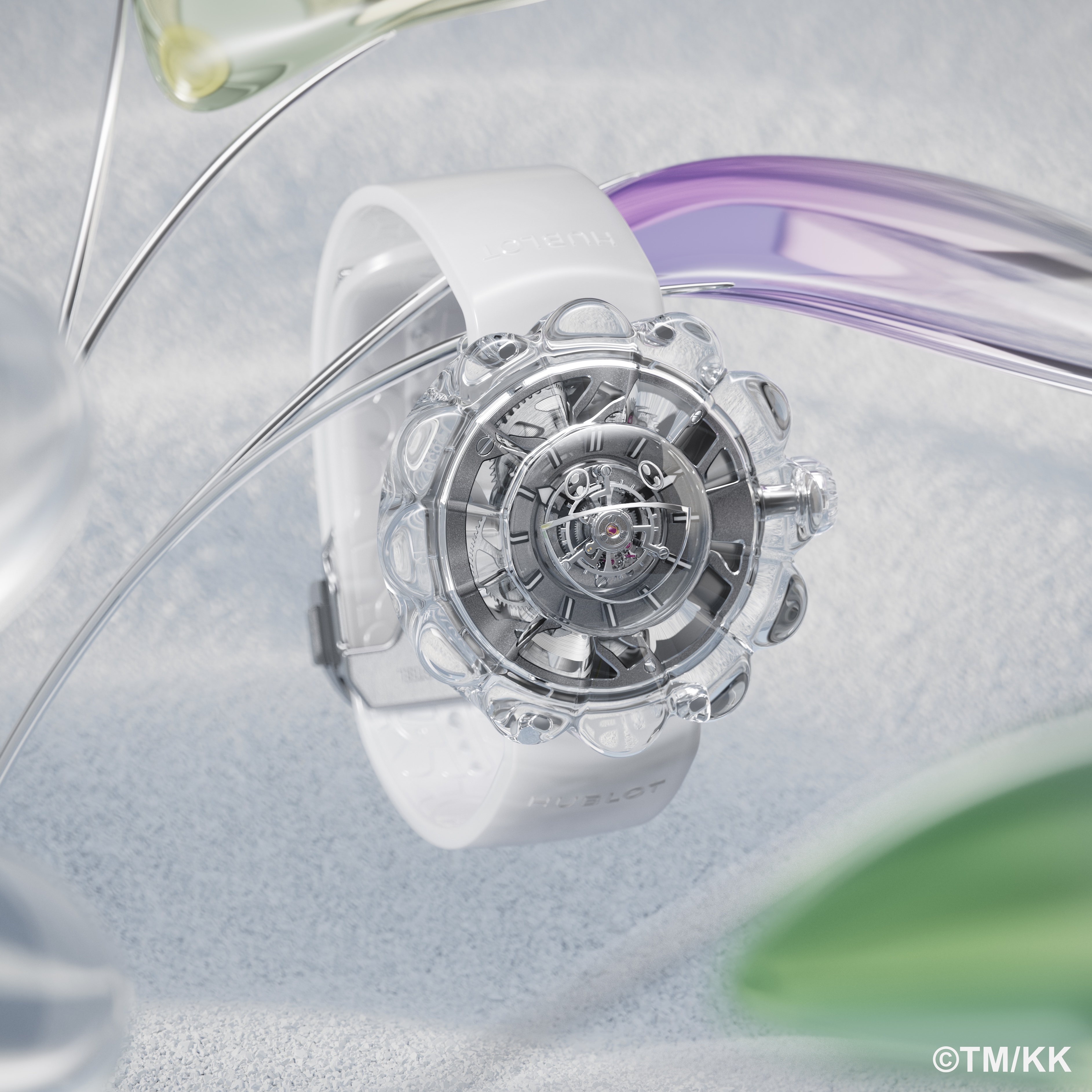
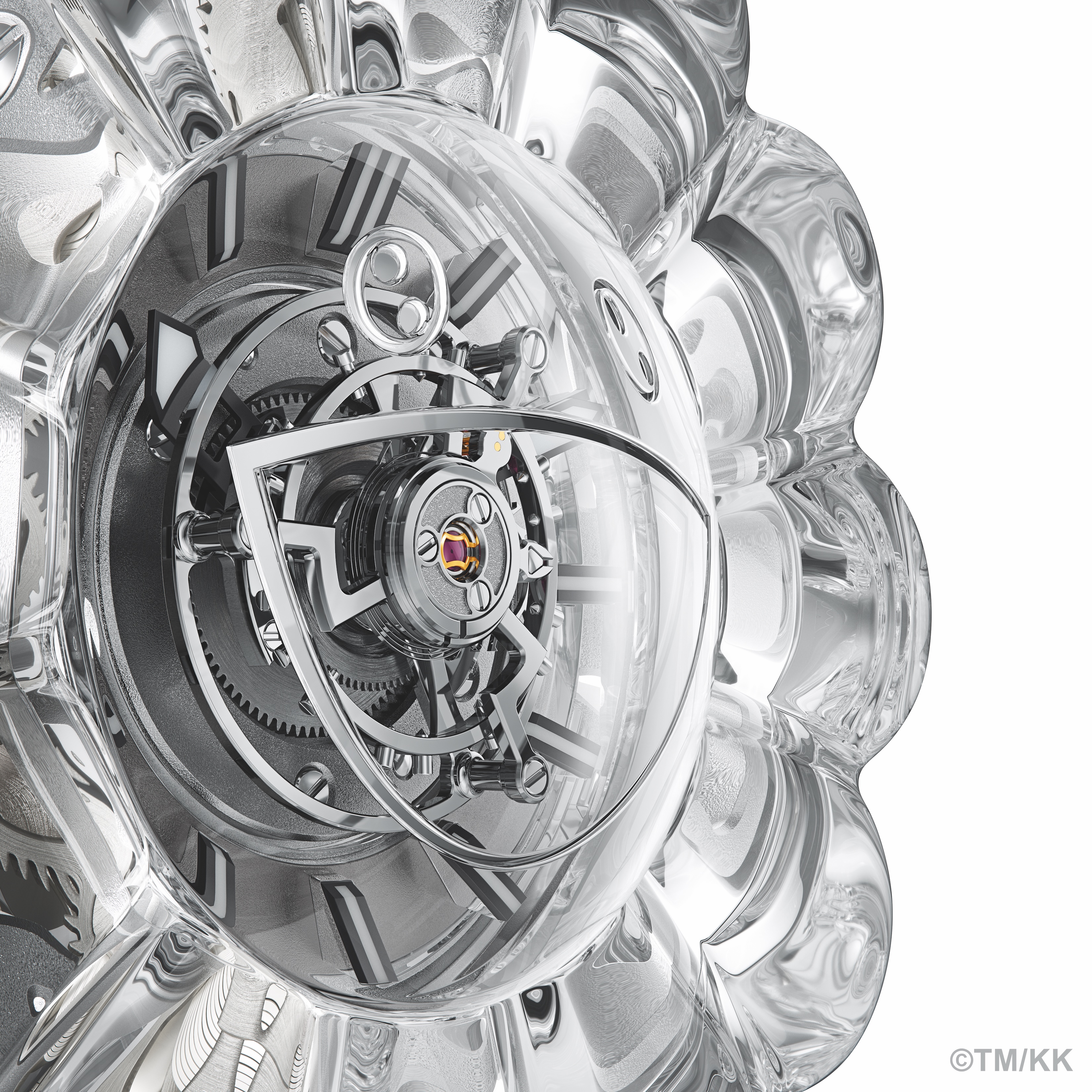
Hublot's continuing partnership with Takashi Murakami is one of the clearest examples. Murakami's smiling flower could easily have become a familiar image printed onto a conventional dial. Instead, Hublot progressively made the motif part of the watch's architecture. On the MP-15 Takashi Murakami Tourbillon, twelve sapphire petals surround Hublot's first series-produced central flying tourbillon, with the case, movement and dial fused into one composition, the complication at the centre and the hands pushed to the periphery. The flower is no longer applied to the watch; it has become the structure the watch is organized around.
The result is exuberant, perhaps even excessive, but restraint has never been central to Murakami's visual language. What's more interesting is that Hublot doesn't reduce that language to a logo. The manufacture answers it with sapphire construction, transparency and mechanical complexity, and the collaboration has developed across several creations rather than ending with a single launch. That continuity matters: a one-off edition can prove that two names look compelling beside each other, but a sustained relationship reveals whether the artist and watchmaker are actually developing an idea.5
Audemars Piguet's collaboration with KAWS creates a different mood and a different technical problem. The Companion figure occupies the centre of the Royal Oak Concept, blocking the conventional placement of the hands, so Audemars Piguet developed a peripheral display that leaves the character unobstructed while still allowing the time to be read around the edge. The tourbillon appears through the Companion's chest like a mechanical heart - an unexpectedly tender detail in a character usually associated with emotional distance and crossed-out eyes.6
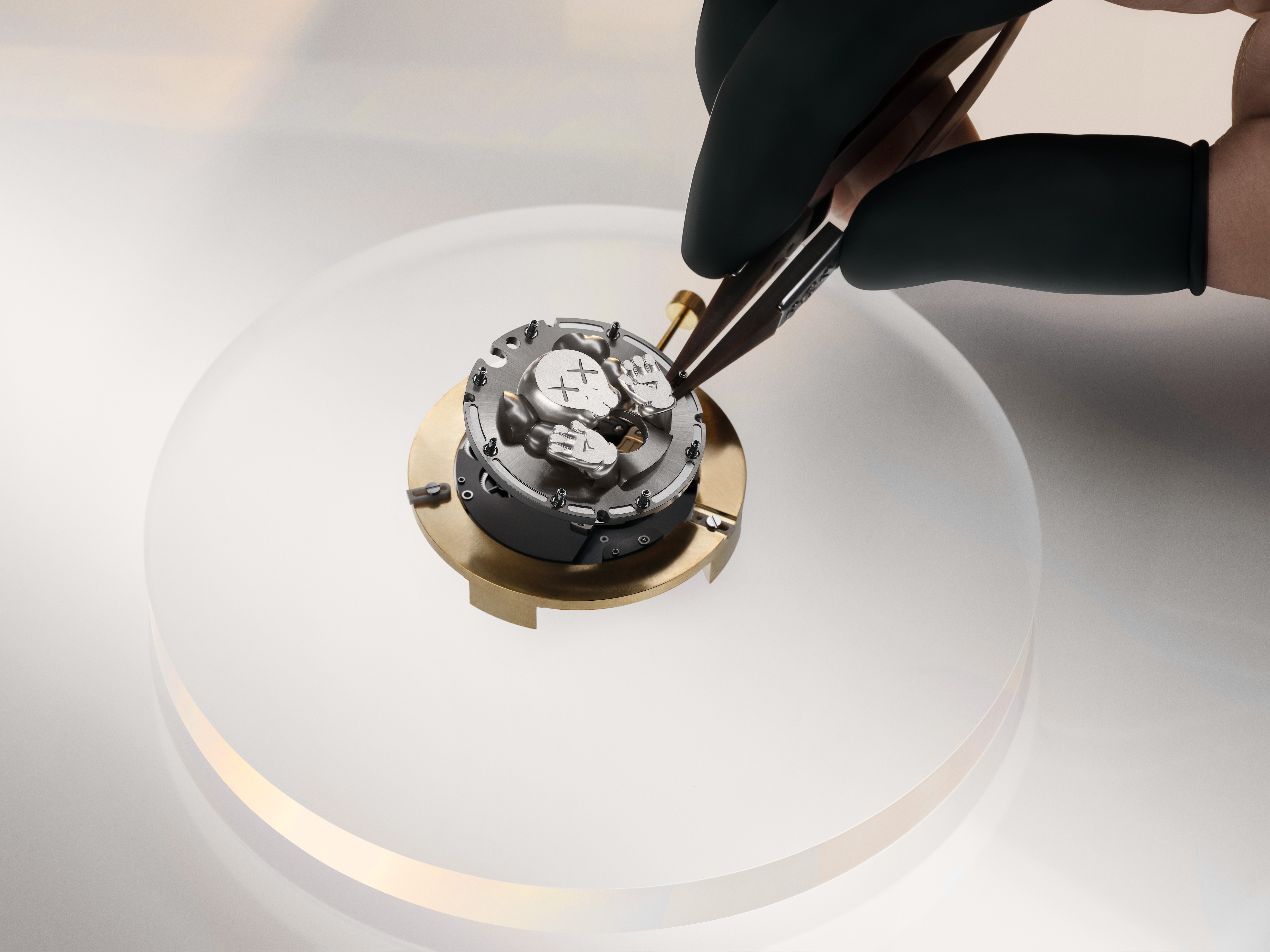

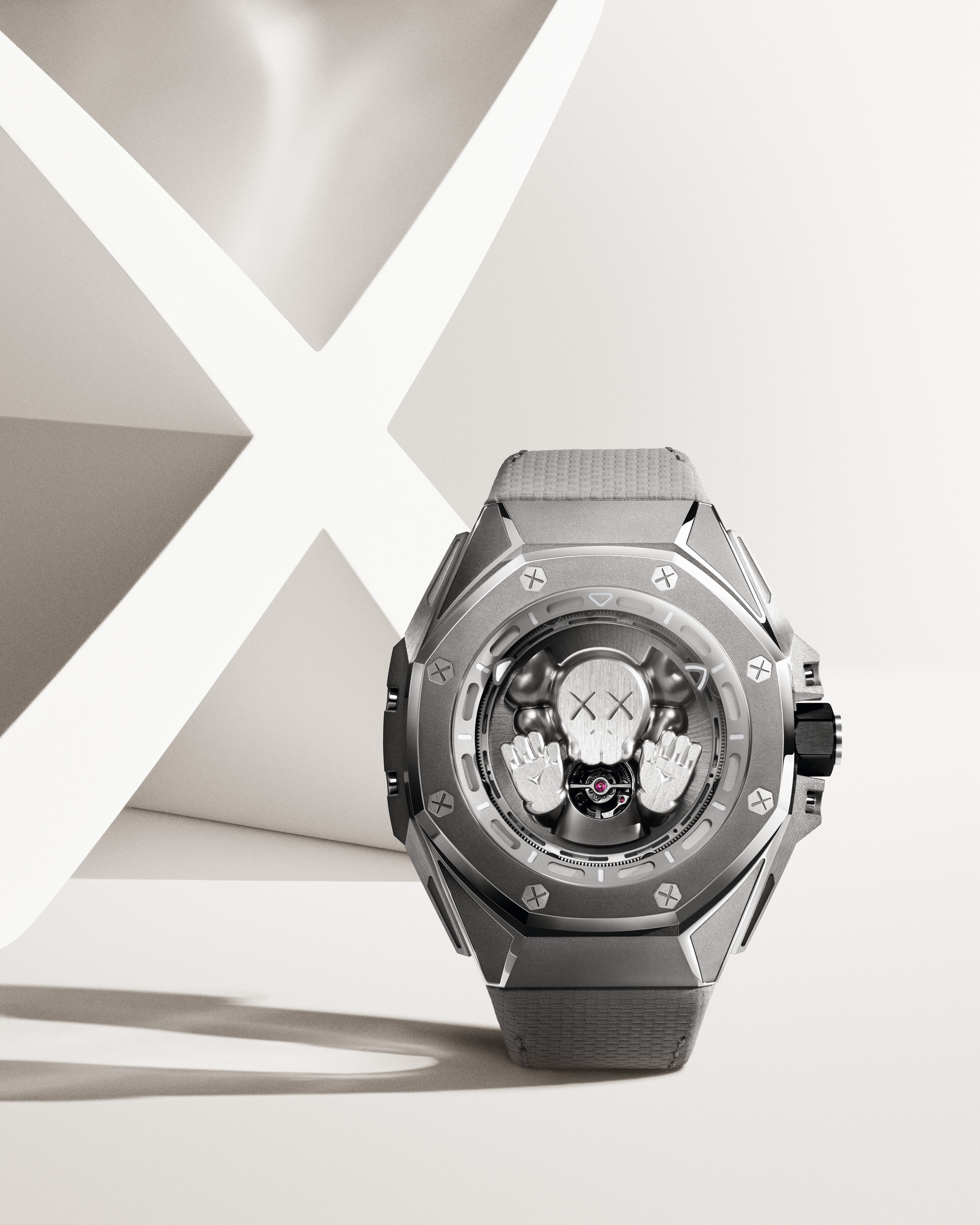
More importantly, the artist's presence changes the logic of the object. Take away the Companion, and the peripheral display has no reason to exist; a conventional watch would simply put the hands back in the centre. The usual order is reversed here. The engineering wasn't finished first, with the art placed on top of it afterward; the art came first, and it's what forced the watchmaker to invent a new way of displaying time.
VIEREN uses the watch as a shared canvas while letting the collaborations shape an identity still being written. Hublot turns an artist's motif into a mechanical structure. Audemars Piguet lets the artwork reshape the display of time.
The strongest partnerships do more than borrow recognition. They create something neither participant would have produced alone.
Van Cleef & Arpels takes a completely different route: the maison builds its own artistic universe from the inside, through mechanics, jewellery craftsmanship and storytelling, without needing an external artwork or artist at all.
This matters in a category where women's watches are still often treated as though decoration and technical achievement sit at opposite ends of a spectrum: a watch featuring diamonds, enamel or miniature painting gets filed as primarily ornamental, while a visibly mechanical men's complication is assumed to carry more technical or intellectual weight. Van Cleef & Arpels shows how thin that distinction really is.
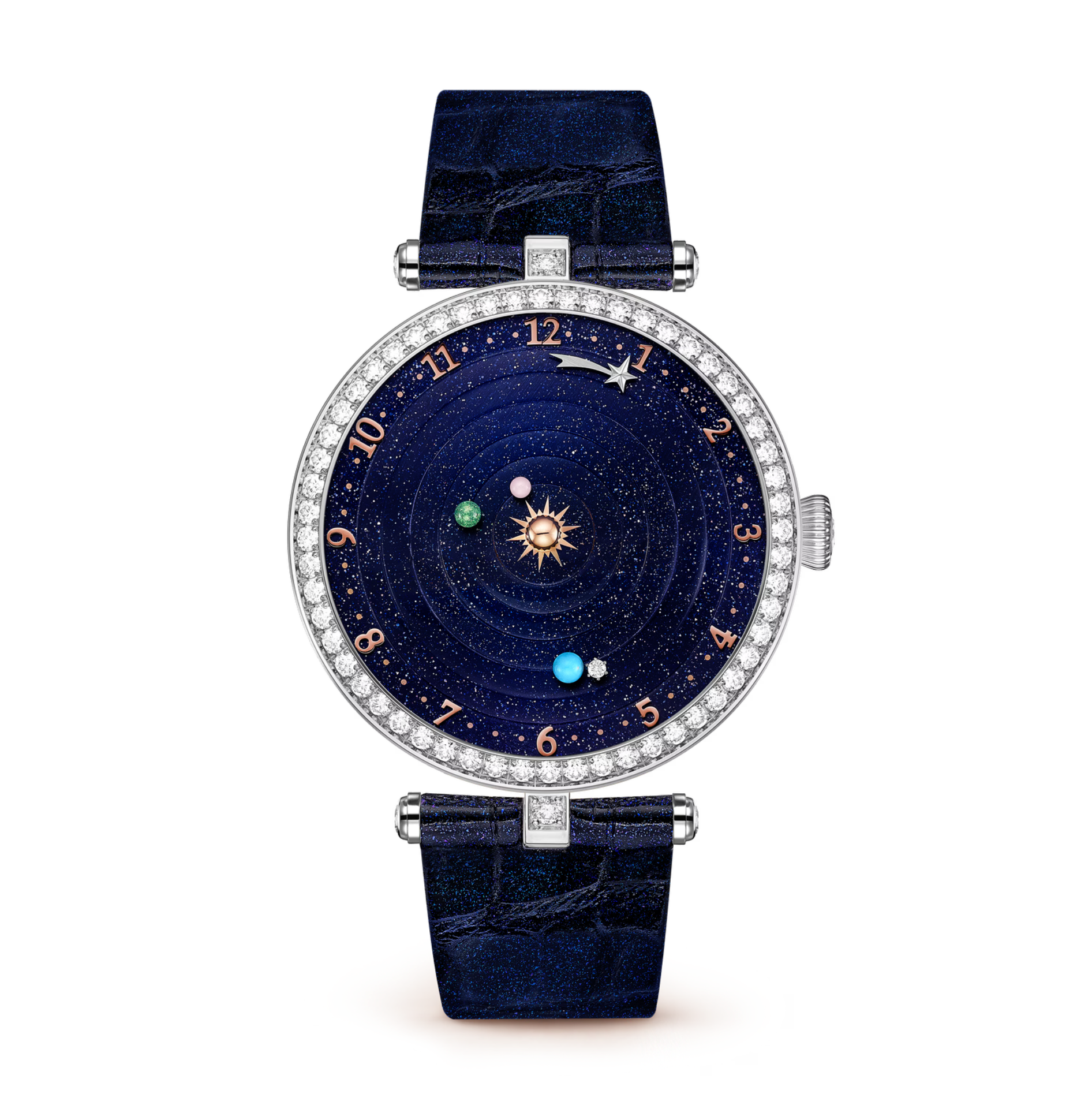
The Lady Arpels Planétarium depicts the Sun, Mercury, Venus and Earth, together with the Moon, using a self-winding movement developed specifically for the maison. Aventurine, mother-of-pearl, turquoise, enamel, gold and diamonds create a celestial scene in motion, with the Moon itself orbiting the Earth over 29.5 days. The watch is mechanically complex, but it doesn't present itself as an engineering exercise. The planets aren't there simply to prove the movement can make them orbit. Their motion creates atmosphere, beauty and wonder, and the technical seriousness usually associated with severity shows up here as something closer to poetry.7
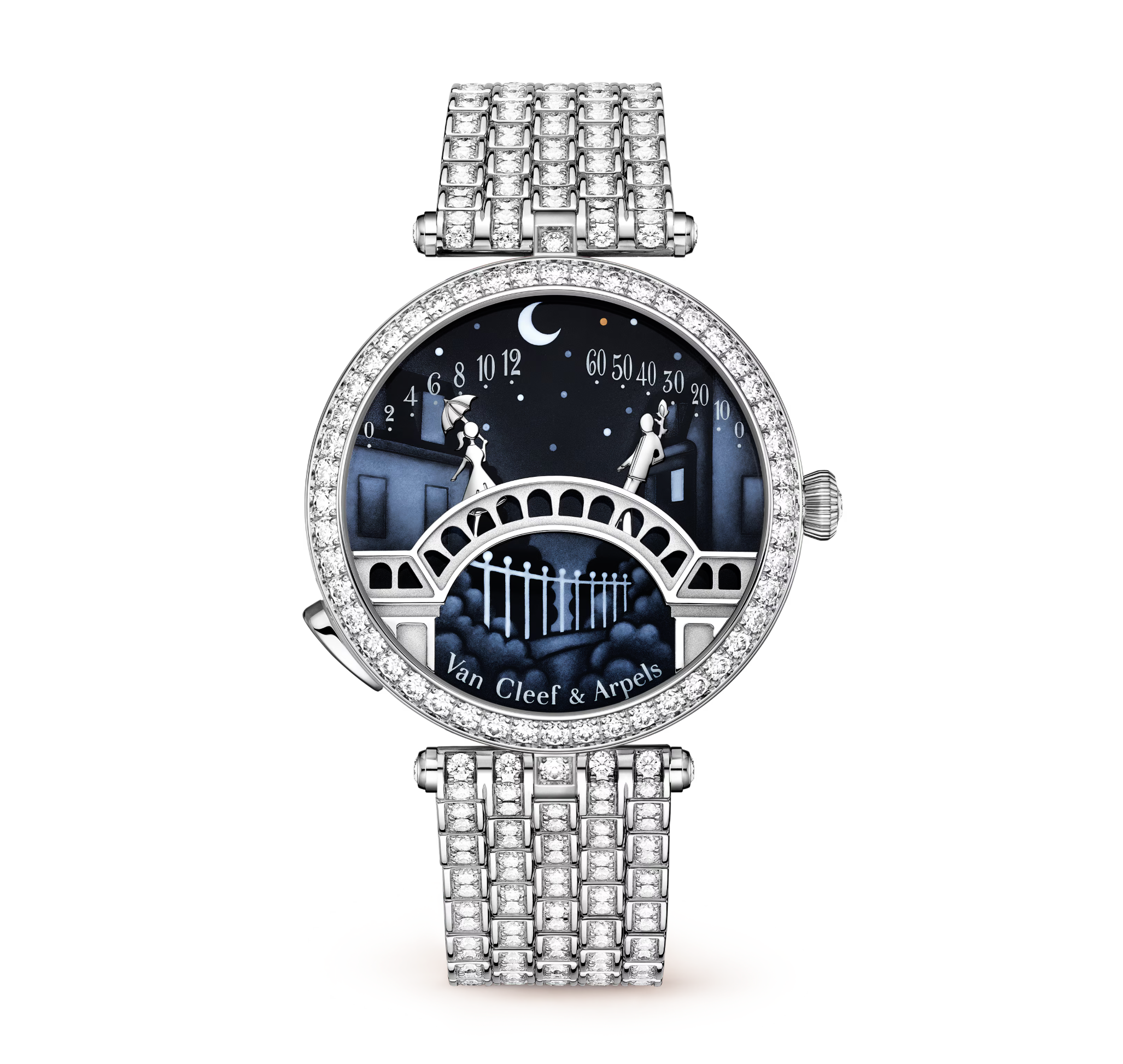
The Lady Arpels Pont des Amoureux turns the passage of time into narrative. Two lovers mark the hours and minutes through retrograde displays, moving toward one another until they meet for a kiss, driven by a self-winding movement built around a retrograde display and an on-demand animation module developed for Van Cleef & Arpels. The narrative and the mechanics can't really be separated: the lovers move toward each other only because time itself drives the scene, and their distance carries emotional weight precisely because it's measured in hours and minutes.8
That's what makes Van Cleef & Arpels relevant well beyond the category of women's watches. The maison shows that jewellery craft doesn't have to soften horological ambition, and that emotion doesn't have to diminish technical credibility. Here, time isn't just displayed: it becomes the material the story is made from.
In 2026, the Metropolitan Museum of Art made the connection between art and adornment explicit. Its Costume Institute exhibition, Costume Art, pairs garments with works from across the museum's collection, while the Met Gala dress code declared "Fashion is Art." The framing felt current, even though the idea of wearing art itself is not.9
Swatch has been exploring that territory for more than four decades. Its first Art Special was created with Kiki Picasso in 1985, followed by Keith Haring Art Specials in 1986. The brand described the watch as the "world's smallest canvas" and brought artistic expression into an object built for daily life.10
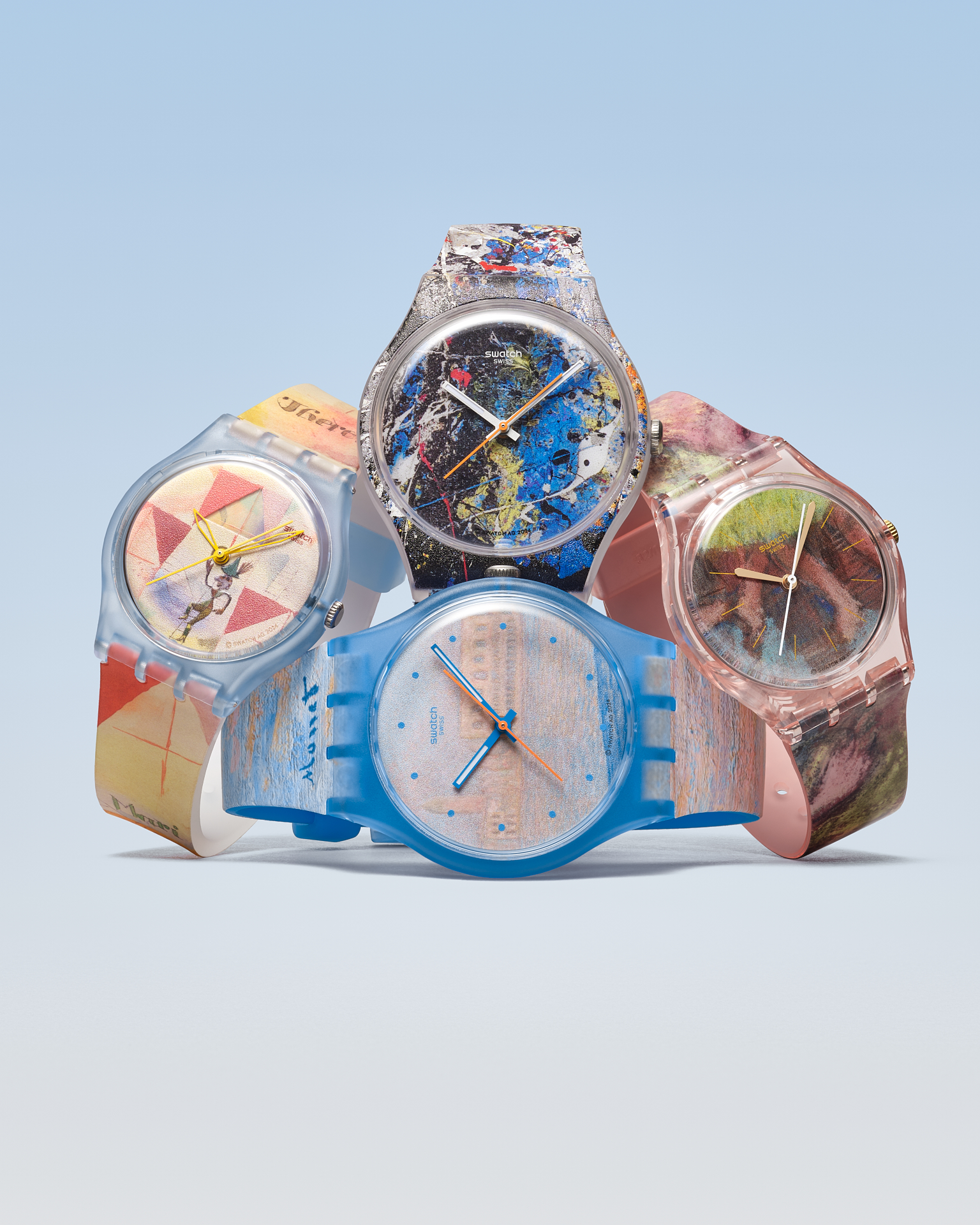
Because Swatch produces these watches at scale, its approach raises a different set of questions from a hand-painted Reverso or one of Vacheron Constantin's métiers d'art pieces. One criticism is that translating a complex work into a widely available product can remove some of its physical and historical context, leaving a familiar fragment, colour palette or instantly recognizable image. That concern is worth taking seriously, but it is not the whole story.
What these collaborations offer in return is a form of access that galleries and museums can't always provide. Art education matters, but not everyone has the opportunity, confidence or built-in interest to study art history or walk into a formal cultural space. A watch can be a smaller, less intimidating point of entry: someone might be drawn in first by a colour or a composition, and only later look up the artist, the original work, or the museum that holds it.
The hierarchy applied to artistic watches often mirrors a hierarchy inside the art world itself: scarcity, handcraft and high prices read as evidence of seriousness, while reproduction and accessibility get dismissed more readily as commercial dilution.
Swatch complicates that assumption.
A mass-produced watch may not carry the rarity of a miniature enamel piece, but it can circulate an image, keep the memory of an exhibition alive, and introduce an artist to an audience the original work would never otherwise reach. Swatch has kept up relationships with artists and institutions rather than treating art as a passing campaign theme. Its Art Journey has included collaborations with Tate, the Museum of Modern Art and the Uffizi, translating works by artists such as Roy Lichtenstein and Sandro Botticelli into wearable designs. These watches don't replicate the experience of standing in front of the original artwork; they offer a different relationship with it, letting a work once encountered inside a gallery or an art book become part of someone's wardrobe, travels and everyday routine.11
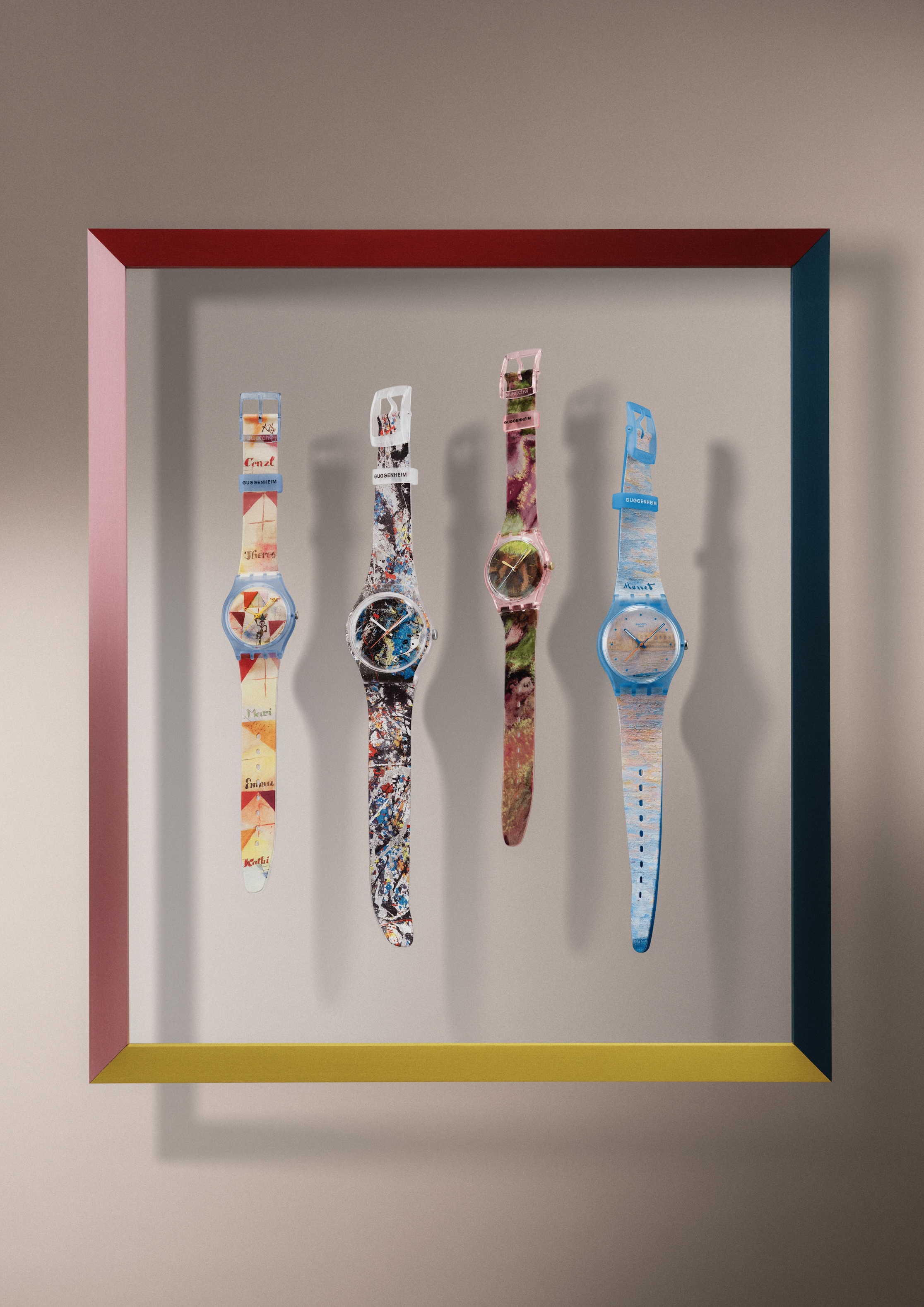
The artwork loses some context when it's reproduced this widely. It also gains an audience it would never otherwise have reached. Both of those things are true at once, and art appreciation doesn't have to require specialist knowledge, real wealth or access to the right institutions for either to matter. A watch can serve as tribute, memory, invitation or conversation starter, and its accessibility doesn't make the connection less sincere; if anything, it's the reason more people get to have one at all.
Swatch is not alone in bringing art to accessible timepieces. Timex's 2023 collaboration with The Metropolitan Museum of Art featured works including Gustav Klimt's Mäda Primavesi and Vincent van Gogh's Self-Portrait with a Straw Hat on watch dials12; G-SHOCK takes a different route, its collaboration with contemporary artist Joshua Vides extending his monochrome, comic-style graphics across the dial, bezel and band.13 What distinguishes Swatch, however, is the consistency and longevity with which it has treated the watch as an artistic canvas. Its history ranges from new work commissioned directly from artists like Kiki Picasso and Keith Haring to long-running partnerships with institutions such as Tate, MoMA and the Uffizi. Taken together, those relationships represent a four-decade commitment to bringing art into accessible watchmaking.
The continuing importance of cultural institutions feels especially visible this year. Guggenheim Abu Dhabi is scheduled to open on December 11, 2026, two decades after the project was first announced. Having attended the opening of Louvre Abu Dhabi in 2017, the announcement felt personal, like the continuation of a cultural story I'd been fortunate enough to watch begin.14
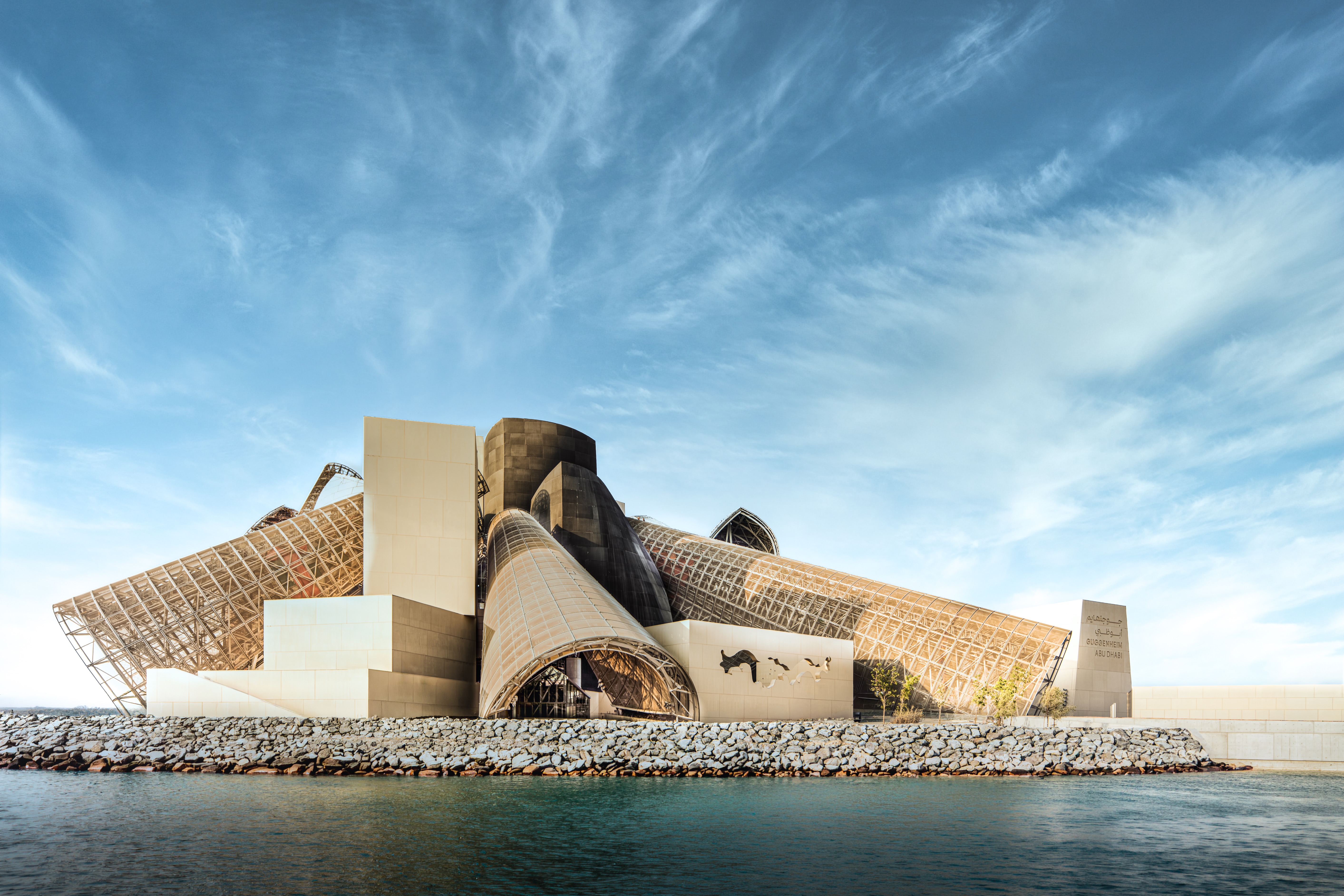
It also reinforced something I learned while working in the art world: objects don't acquire meaning in isolation. Museums, scholarship, display and storytelling all shape how they're understood, and the watch industry's pursuit of the art world can look straightforward from the outside: art offers prestige, museums offer authority, recognized artists offer cultural relevance and access to audiences beyond traditional watch collecting. But standing next to art isn't the same as earning cultural significance from it.
Jaeger-LeCoultre draws directly from the artistic canon through Hokusai, but its place in that conversation depends on the quality of the translation, not the stature of the source alone. Vacheron Constantin adds a living institution to that equation: its partnership with the Louvre brings curatorial research into the process, the museum supplying the knowledge and the manufacture translating it into material form. Swatch draws from the same cultural ecosystem but distributes those connections differently, trading rarity for reach.
Contemporary partnerships create a different kind of exchange. Hublot and Audemars Piguet invite living artists to interrupt established codes and pose new technical problems for the manufacture to solve. VIEREN's position is more formative: a younger brand doesn't have an archive of recognized design language to defend, so collaboration helps define what it will become. Van Cleef & Arpels stands apart from both: its authority comes from within, built through jewellery, nature, romance and narrative rather than borrowed from an outside artist or institution.
None of these models is automatically more authentic than the others; what matters is how faithfully the idea was carried out. Does the artistic idea change the object or ask the watchmaker to solve a problem that wouldn't otherwise exist? Does it change how the audience sees the art, the artist or the timepiece?
The connection turns superficial when cultural prestige stands in for creative thought, or when the artist's name is louder than their actual contribution. The proof is in the finished watch: take away the artistic idea, and the object should lose more than its decoration.
The meeting of art and watchmaking takes many forms. A historic work can be reinterpreted through enamel so detailed that the wearer has to turn the watch over and lean in close to see it. An ancient object can be reconstructed through scholarship and métiers d'art. A living artist can force a watchmaker to reinvent the display of time. A maison can build an original world of planets, lovers and dreams. A museum masterpiece can turn up on a Swatch and introduce itself to someone who might never have encountered it any other way.
These watches differ radically in technique, audience and price. What connects them isn't a shared aesthetic or a shared level of exclusivity: it's the degree to which the artistic idea actually transforms the object. The artwork changes the watch, the watch changes how the artwork is encountered, or the collaboration changes how the brand understands itself. In the strongest cases, more than one of those things happens at once.
I think about the Companion again, at the end of all this - that small mechanical heart beating behind KAWS' flat, crossed-out eyes, doing the one thing neither a painting nor a plain watch could do on its own. That's the measure, in the end. Not whether a name is famous enough, or a material rare enough, but whether something in the object actually had to change for the art to be there at all. The best of these watches don't just borrow a little of art's weight to feel more serious. They find a way to keep moving, on somebody's wrist, long after the gallery lights go down.
1. Audemars Piguet. “AP x KAWS Welcomes a 'Companion'.” 2024. https://www.audemarspiguet.com/us/en/watch/royal-oak-concept-tourbillon-companion
2. Jaeger-LeCoultre. “Introducing Reverso Tribute Enamel Hokusai Waterfalls Series.” April 2026. https://press.jaeger-lecoultre.com/introducing-reverso-tribute-enamel-hokusai-waterfalls-series/
3. Vacheron Constantin. “Tribute to Great Civilisations.” 2026. https://www.vacheron-constantin.com/ww/en/watches/explore-all-ways-possible/tribute-to-great-civilisations.html
4. VIEREN. “About VIEREN.” n.d. https://vieren.co/pages/about; VIEREN. “V Collection: One-of-One Artist Watches.” 2025. https://vieren.co/collections/v/
5. Hublot. “Floral Sapphire and Central Tourbillon: Hublot Unveils the MP-15, Developed with Takashi Murakami.” 10 November 2023. https://www.hublot.com/en/news/floral-sapphire-and-central-tourbillon-hublot-unveils-mp-15-developed-takashi-murakami
6. Audemars Piguet. “AP x KAWS Welcomes a 'Companion'.” 2024. https://www.audemarspiguet.com/us/en/watch/royal-oak-concept-tourbillon-companion
7. Van Cleef & Arpels. “Lady Arpels Planétarium Watch.” n.d. https://www.vancleefarpels.com/ca/en/collections/watches/poetic-complications/vcaro8r500---lady-arpels-planetarium-watch.html
8. Van Cleef & Arpels. “Lady Arpels Pont des Amoureux Watch.” n.d. https://www.vancleefarpels.com/en/collections/watches/poetic-complications/vcaro90900---lady-arpels-pont-des-amoureux-watch.html
9. The Metropolitan Museum of Art. “The Met Announces New Details for the 2026 Met Gala and Spring Costume Art Exhibition.” 23 February 2026. https://www.metmuseum.org/press-releases/costume-institute-spring-2026
10. Swatch. “Swatch & Art: Four Decades of Creative Collaborations.” n.d. https://www.swatch.com/en-ca/watches/art-watches/swatch-art-history.html
11. Swatch. “Swatch Art Journey.” n.d. https://www.swatch.com/en-en/watches/art-watches/art-journey.html
12. Timex. “Time Meets Art: Unveiling Our Collab with The Met Museum.” 2023. https://timex.com/blogs/the-timex-blog/time-meets-art-unveiling-our-collab-with-the-metropolitan-museum-of-art
13. CASIO G-SHOCK. “Joshua Vides x G-SHOCK.” 2026. https://gshock.casio.com/us/products/collection/limited/joshua-collab/
14. Abu Dhabi Media Office. “Department of Culture and Tourism, Abu Dhabi Announces Opening of Guggenheim Abu Dhabi on 11 December 2026.” 28 July 2026. https://www.mediaoffice.abudhabi/en/arts-culture/department-of-culture-and-tourism-abu-dhabi-announces-opening-of-guggenheim-abu-dhabi-on-11-december-2026/
%201.png)
